
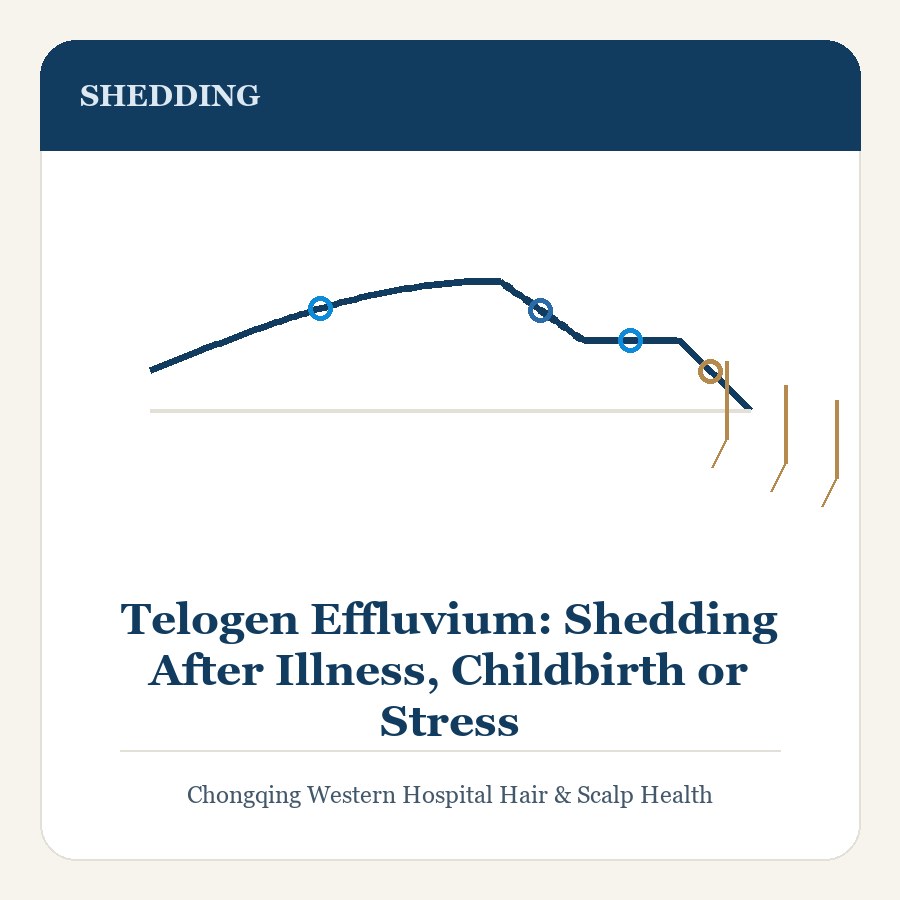
In short. Telogen effluvium is diffuse hair shedding that follows a disturbance pushing an abnormal number of follicles into the resting phase at once. The shed arrives two to three months later, by which time the trigger has usually passed. It is not scarring, the scalp looks normal, and it is self-limiting once the cause is removed.
Key points
- Diffuse shedding, not patchy; temples, sides and crown are usually worst.
- The trigger comes two to three months earlier, so it is often missed.
- Recognised triggers include fever, surgery, childbirth, crash dieting, stress and some medicines.
- Low iron stores and thyroid disease produce the same pattern and are treatable.
- Beyond six months without a clear trigger, it is chronic and needs a cause search.
Why the shed arrives months after the trigger
Telogen effluvium is a shedding condition rather than a scarring one. A disturbance pushes an abnormal number of follicles out of the growth phase and into the resting phase at the same time. Three months later those follicles all release their hairs together, and the person experiences a sudden, diffuse shedding that seems to come from nowhere. The delay is the reason the trigger is so often missed: by the time hair is falling, the illness, the operation or the stressful period is already over.
What triggers telogen effluvium?
Any significant physical stress can do it. A high fever or a severe infection, a general anaesthetic and surgery, childbirth, a crash diet or rapid weight loss, major psychological stress, and some medicines are all recognised causes. Nutritional factors such as low iron stores, or an underactive or overactive thyroid, can produce the same pattern, and they are worth excluding because they are treatable.
| Trigger group | Recognised examples | When shedding starts | What changes the course |
|---|---|---|---|
| Physical stress | High fever, severe infection, general anaesthetic and surgery | About three months after the trigger | The trigger has usually passed by the time hair falls; regrowth follows over six to twelve months |
| Childbirth | Delivery | Two to four months after delivery | Settles over the following six to twelve months |
| Nutritional and metabolic | Crash diet, rapid weight loss, low iron stores, underactive or overactive thyroid | Same pattern, with no fixed delay | Correcting the deficiency or treating the thyroid problem |
| Psychological | Major psychological stress | About three months after the stressful period | The stressful period is usually over before shedding settles; regrowth follows over six to twelve months |
| Medicines | Some medicines | About three months after the trigger | Reviewed with the prescriber |
Childbirth is the classic example: shedding typically begins two to four months after delivery and settles over the following six to twelve months.
What it looks like, and how it is told apart
Loss is diffuse rather than patchy, and it is usually worst over the temples, the sides and the crown. The scalp looks normal. A pull test releases more hairs than expected from multiple sites. Trichoscopy shows an increased proportion of resting hairs but no variation in shaft diameter, which is the finding that separates telogen effluvium from pattern hair loss, and no perifollicular scaling or loss of openings, which separates it from scarring alopecia.
How long does it last, and when does it become chronic?
Acute telogen effluvium is self-limiting. Once the trigger has passed and any deficiency has been corrected, shedding settles and hair regrows over six to twelve months. It is worth saying plainly that regrowth is slow, that the scalp may look thinner for a while before it recovers, and that shedding more than usual does not mean going bald. When shedding continues beyond about six months without a clear trigger it is called chronic telogen effluvium, and it needs a more careful search for an ongoing cause, including thyroid disease, iron deficiency, and coexisting pattern hair loss, which is often unmasked at the same time.
What actually helps
Removing the cause where one can be found, correcting a deficiency if it is present, treating any coexisting pattern hair loss, and giving it time. Treatments aimed at speeding up growth have a limited role here; the priority is to establish what is driving the shedding rather than to add products.
When to arrange an assessment
- Shedding continues beyond six months, or has no identifiable trigger at all.
- Loss is patchy, the scalp is itchy, scaly or inflamed, or the hair shafts themselves are breaking.
- You also have fatigue, palpitations, weight change, heavy periods, or other symptoms of a systemic cause.
Sources
- British Association of Dermatologists — telogen effluvium patient information
- National Institute for Health and Care Excellence, Clinical Knowledge Summaries — hair loss (alopecia)
- American Academy of Dermatology — hair loss: diagnosis and treatment
Internal links
Frequently asked questions
Why does shedding start months after the trigger?
A disturbance pushes an abnormal number of follicles into the resting phase at the same time. Roughly three months later those follicles release their hairs together, which is why the illness, operation or stressful period is usually already over by the time hair falls.
How long does telogen effluvium last?
Acute telogen effluvium is self-limiting. Once the trigger has passed and any deficiency is corrected, shedding settles and hair regrows over six to twelve months. Regrowth is slow, and the scalp may look thinner for a while before it recovers.
Does heavy shedding mean I am going bald?
Not in telogen effluvium. Shedding more than usual does not mean going bald, and the scalp looks normal. When shedding continues beyond about six months without a clear trigger, it is called chronic telogen effluvium and needs a more careful search for an ongoing cause.
Risks & Limitations
- Most hair loss is progressive and managed rather than reversed; treatment holds the line more often than it restores it.
- Treatment takes 6–12 months before a response can be judged fairly, and must usually be continued indefinitely to keep the result.
- Stopping treatment commonly means losing the hair that was regained, usually within months.
- Some oral agents cause sexual, mood and metabolic side effects, and several require blood monitoring, blood-pressure monitoring, or pregnancy prevention.
- Hair transplantation moves existing hair; it does not create new hair and does not stop the underlying process.
- Scarring alopecia destroys the follicle permanently, so hair lost before treatment begins cannot be recovered.
- No treatment works for everyone, and response cannot be predicted with certainty.
When to Seek Care
- Sudden patchy hair loss, especially with scalp redness, scaling, itching or pain.
- Hair loss with fever, joint pain, mouth ulcers, or a rash elsewhere on the body.
- Scarring changes: an area of scalp that has become smooth, shiny or pale, with loss of the follicular openings.
- Eyebrow or eyelash loss, which suggests a more extensive or systemic process.
- Hair loss with fatigue, palpitations, weight change, or heavy or irregular periods — a systemic cause needs excluding.
References & Further Reading
- American Academy of Dermatology (AAD) — public and clinical guidance on hair and scalp disorders
- Chinese Medical Association, Dermatology Branch — clinical guidance
- Cochrane Library — systematic reviews in dermatology
- World Health Organization (WHO) — general health and nutrition resources
This page is patient education, not medical advice, and it does not cite individual studies. Discuss your own case with a qualified clinician. To arrange an assessment at Chongqing West District Hospital, see Contact & Consultation.